PLA vs PETG: Which Filament Should You Use?
Choose PLA for easy, detailed prints that stay indoors. Choose PETG for parts that need to be tough, take heat or go outside. If you are not sure, start with PLA: it is the easiest filament to print well.
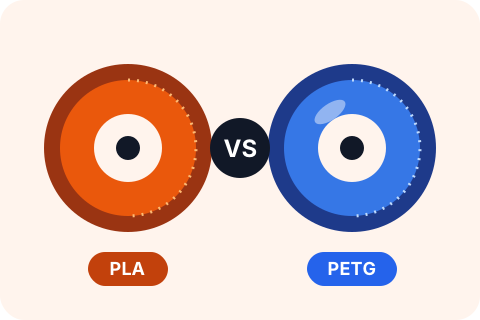
Quick answer: PLA is easier to print, stiffer and gives sharper details. PETG is tougher, handles about 20 °C more heat and lasts longer outdoors, but it strings more and needs higher temperatures. Both cost about the same.
PLA vs PETG at a glance
| Property | PLA | PETG |
|---|---|---|
| Ease of printing | Easiest of all filaments | Easy, but strings more |
| Nozzle temperature | 190–220 °C | 230–250 °C |
| Bed temperature | 50–60 °C | 70–90 °C |
| Softens at about | 55–60 °C | 75–80 °C |
| Toughness | Stiff, brittle, snaps | Tough, bends before breaking |
| Outdoor use | Poor in sun and heat | Good |
| Water and chemicals | Fair | Good |
| Surface and detail | Matte or satin, very sharp | Glossy, slightly softer details |
| Density | 1.24 g/cm³ | 1.27 g/cm³ |
| Enclosure needed | No | No |
Temperatures are typical ranges. Always start with the settings printed on your spool, because brands and blends differ.
Strength: is PETG stronger than PLA?
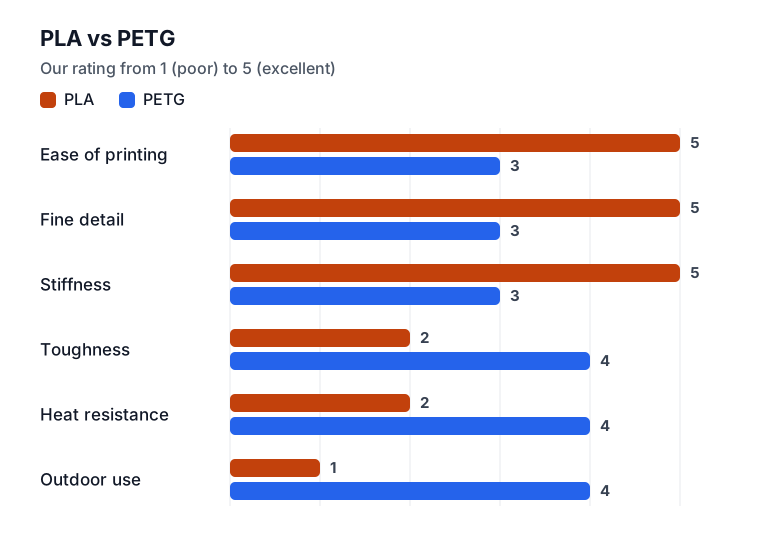
It depends on what you mean by strong. PLA is stiff: it barely bends under load and often scores as well as PETG in a simple pull test. But it is brittle, so when it fails it snaps.
PETG is tough. It flexes a little, absorbs knocks and usually bends or cracks slowly instead of shattering. Its layers also bond very well. For clips, brackets, tool holders and anything that gets dropped or screwed down, PETG lasts longer.
Heat resistance
PLA starts to soften at about 55 to 60 °C. That sounds high, but a dark part on a sunny windowsill or inside a parked car can get hotter than that and slowly warp. PETG keeps its shape up to about 75 to 80 °C, which covers most sunny and warm places. Neither is suitable for parts near a hot engine or a heater.
Outdoor use
PETG is the better choice outside. It takes heat better, does not mind rain and copes with sunlight for a long time, although colours can fade. PLA tends to warp in summer sun and becomes brittle over time. For parts that live outside for years, see our guide to the best filament for outdoor use.
Ease of printing
PLA
PLA prints at low temperatures, barely warps and bridges and overhangs well. It forgives a less than perfect setup, which is why most printers ship with PLA settings and sample spools.
PETG
PETG needs higher temperatures and tends to string, leaving fine hairs between parts. More retraction, a slightly lower nozzle temperature and good cooling help. PETG also sticks very strongly to smooth PEI and glass, sometimes strongly enough to tear the surface. Use a textured sheet, or a thin layer of glue stick as a release agent.
Both materials absorb moisture from the air, and PETG suffers more from it. Wet PETG pops, strings and prints weak parts. Store it in a sealed box with desiccant and dry it if prints suddenly get worse.
Cost
Standard PLA and PETG usually sell for about the same price per kilogram. PETG is about 2% denser, so a model that needs 100 g of PLA needs roughly 102 g of PETG. In practice the difference is a few cents per print. Specialty versions such as silk PLA or carbon-fibre PETG cost more.
Which one should you choose?
Choose PLA for
- Your first prints and prototypes
- Figures, models and decorations
- Detailed parts with overhangs
- Anything that stays indoors and cool
Choose PETG for
- Functional parts, clips and brackets
- Parts in sun, cars or warm rooms
- Outdoor parts and planters
- Parts that get dropped or flexed
Many makers keep both: PLA for everyday prints and PETG for parts that have to work. Once your printer runs PLA well, PETG is the natural next step.
Frequently asked questions
Is PETG stronger than PLA?
PETG is tougher: it bends before it breaks and handles knocks, heat and outdoor use better. PLA is stiffer and can be just as strong in a simple pull test, but it is brittle and snaps instead of bending. For parts that take impacts or flex, PETG is the stronger choice in practice.
Can I print PETG on any printer that prints PLA?
Most modern printers can. PETG needs a nozzle around 230 to 250 °C and a bed around 70 to 90 °C. Printers with a PTFE tube that runs all the way to the nozzle should stay at or below about 240 °C.
Is PLA or PETG better for outdoor use?
PETG. PLA starts to soften at about 55 to 60 °C, which a part in direct sun or a hot car can reach. PETG holds its shape up to about 75 to 80 °C and copes better with moisture and sunlight. For long-term outdoor parts, ASA is better still.
Is PLA or PETG cheaper?
Standard PLA and PETG usually cost about the same per kilogram. PETG is slightly denser, so the same model uses about 2% more PETG by weight.
Is PETG food safe?
The plastic itself is used for food packaging, but a 3D print is not automatically food safe. Bacteria can grow in the layer lines, and the nozzle, colour and additives also matter. Do not use plain PLA or PETG prints for repeated food contact.