How Much Does a 3D Print Cost? Real Examples from 10 g to 1 kg
A typical PLA print costs about 2 cents per gram in filament plus a few cents of electricity. Count printer wear, failed prints and your own time, and the real cost of a small print can be many times higher.

Quick answer: with filament at $20 per kg, a 50 g print uses about $1.00 of filament and $0.06 of electricity. Add printer wear, a 5% failure rate and 10 minutes of your time, and the same print really costs about $4.77.
Five example prints
All examples use PLA at $20 per kg, a printer that averages 120 W and electricity at $0.17 per kWh. Print times are typical estimates; your slicer gives the real ones.
| Weight | Time | Filament | Electricity | Material cost | Full cost | |
|---|---|---|---|---|---|---|
| Keychain | 10 g | 1 h | $0.20 | $0.02 | $0.22 | $3.67 |
| Phone stand | 50 g | 3 h | $1.00 | $0.06 | $1.06 | $4.77 |
| Desk organizer | 150 g | 6 h | $3.00 | $0.12 | $3.12 | $7.25 |
| Large vase | 500 g | 18 h | $10.00 | $0.37 | $10.37 | $16.14 |
| Big cosplay part | 1,000 g | 36 h | $20.00 | $0.73 | $20.73 | $28.95 |
Material cost is filament plus electricity. Full cost also adds printer wear ($500 printer over 5,000 hours), a 5% failure rate and 10 minutes of hands-on time at $20 per hour.
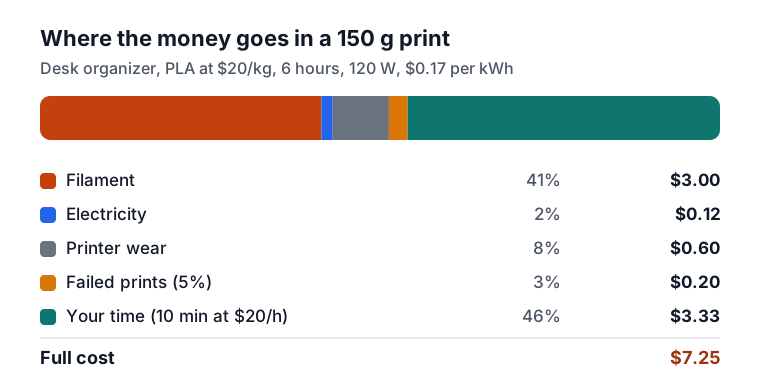
What makes up the cost
Filament: the biggest material cost
Divide the spool price by its weight to get the cost per gram. Filament prices vary by brand and material, so here is what different spool prices mean per gram:
| 1 kg spool price | Per gram | A 50 g print | A 150 g print |
|---|---|---|---|
| $15 | $0.015 | $0.75 | $2.25 |
| $20 | $0.020 | $1.00 | $3.00 |
| $30 | $0.030 | $1.50 | $4.50 |
| $50 | $0.050 | $2.50 | $7.50 |
The filament cost calculator also shows the cost per meter and how much filament is on your spool.
Electricity: smaller than most people think
At 120 W, an hour of printing uses 0.12 kWh. At $0.17 per kWh that is about 2 cents. Even a 36-hour print costs well under a dollar in electricity. Where power is expensive, such as €0.30 per kWh, it roughly doubles, but it is still a small share. Check your own numbers with the electricity cost calculator.
Printer wear
Nozzles, belts, build plates and eventually the whole printer wear out. Spread the printer price over its expected life: a $500 printer that lasts 5,000 print hours costs $0.10 per hour.
Failed prints
Every failed print wastes filament, power and machine time. With a 5% failure rate you need about 1.05 attempts per good part, so add roughly 5% to the material and wear cost.
Your time
Slicing, starting the print, removing supports and packing take time even when the printer does the work. For small prints this is the largest cost by far, which is why a keychain that uses 20 cents of filament still costs several dollars to make if you value your time.
When do you need the full cost?
- Printing for yourself: material cost (filament plus electricity) is enough.
- Selling prints: use the full cost, then add fees and profit. Our guide on how to price 3D prints walks through it.
How the numbers were calculated
Every figure on this page comes from the same formulas as our 3D print cost calculator, which shows each formula. The spool price, power draw and electricity price are example values, so put in your own for an exact result.