How to Price 3D Prints for Selling: A Simple Formula
Price a 3D print from its full cost, not its filament. Add your time, failed prints, packaging and marketplace fees, then choose the profit margin you want. Here is the formula and a worked example.
The formula: price = (full cost + packaging + fixed fees) ÷ (1 − fee % − profit margin %). For a print that costs $7.25 to make, with $0.75 packaging, 10% plus $0.30 in fees and a 40% margin, that gives $16.60.
Step 1: Find the full cost of one print
The full cost is more than filament. Include all of these:
- Filament: print weight ÷ spool weight × spool price.
- Electricity: average watts ÷ 1000 × hours × price per kWh.
- Printer wear: printer price ÷ lifetime hours × print hours.
- Failed prints: about 5% extra at a 5% failure rate.
- Your time: minutes of hands-on work × your hourly rate ÷ 60.
The 3D print cost calculator in Advanced mode adds all five. For a 150 g desk organizer that prints in 6 hours, it comes to about $7.25. See how much a 3D print costs for the breakdown.
Step 2: Add costs per order
Packaging, labels, bags and small extras such as magnets or inserts belong to the order, not the print. In the example they add $0.75.
Step 3: Account for selling fees
Marketplaces and payment providers usually take a percentage of the sale, sometimes plus a fixed amount per order. Add the percentages together, and the fixed amounts together. Fees change and differ by country, so check your platform's current fee page. The example uses 10% plus $0.30.
Percentage fees are taken from the selling price, not from your cost. That is why you divide by (1 − fee %) instead of simply adding the fee on top.
Step 4: Choose your profit
You can think about profit in two ways:
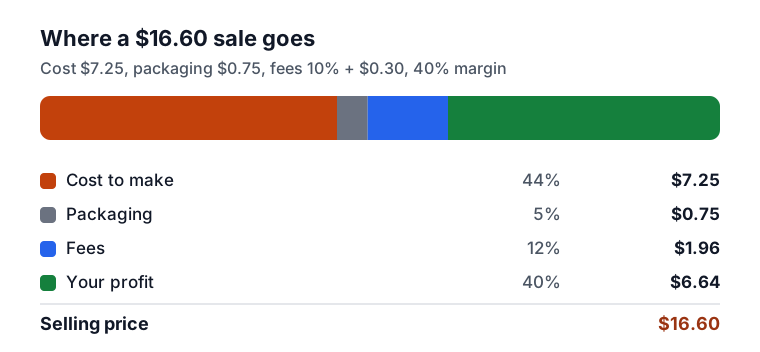
- Margin is the share of the price you keep. A 40% margin on a $16.60 sale means $6.64 profit.
- Markup is added on top of your cost. A 100% markup doubles the cost.
Margin is easier to plan with, because it already accounts for fees. Many sellers end up at two to four times their filament and electricity cost, but your market decides what works.
Worked example
| Item | Amount |
|---|---|
| Full cost to make | $7.25 |
| Packaging | $0.75 |
| Fees | 10% + $0.30 |
| Target margin | 40% |
| Selling price | $16.60 |
| Fees paid | $1.96 |
| Profit | $6.64 |
| Break-even price | $9.22 |
The calculation: ($7.25 + $0.75 + $0.30) ÷ (1 − 0.10 − 0.40) = $8.30 ÷ 0.50 = $16.60. Below $9.22 every order loses money.
Step 5: Check the market
Look at what similar items sell for. If your price is far above them, find cost savings or a way to add value, such as custom colors, names or faster shipping. If it is far below, you may be leaving money on the table.
Common pricing mistakes
- Pricing from filament alone and forgetting your time.
- Adding the fee percentage to the cost instead of dividing by it, which leaves you short.
- Ignoring failed prints on long or tricky parts.
- Forgetting packaging and shipping materials.
- Never updating prices when filament or fees change.
These are planning numbers, not tax or legal advice. Check local rules before you start selling.