PLA vs PETG vs ABS vs ASA: Filament Comparison Chart
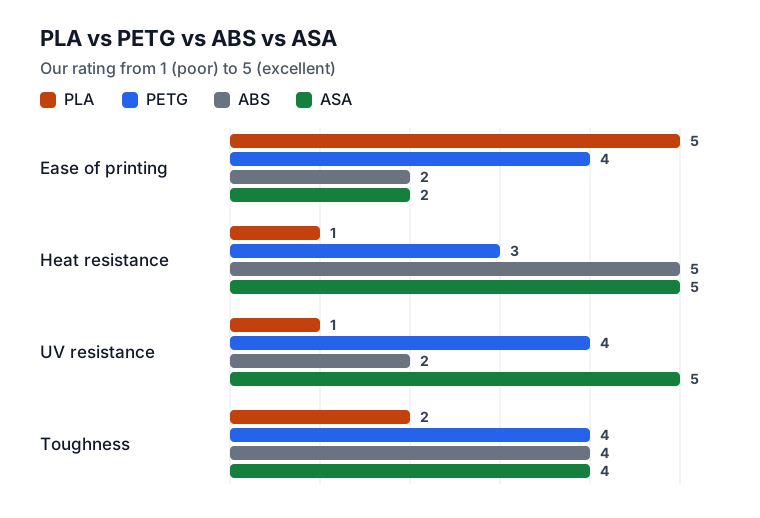
PLA is the easiest to print, PETG is the best all-rounder, ABS handles heat, and ASA handles heat and sun. If your printer is open, choose between PLA and PETG; ABS and ASA need an enclosure.
Quick answer: start with PLA. Move to PETG for tough or warm parts. Use ABS for hot places indoors and ASA for parts outside, both on an enclosed printer.
Filament comparison chart
| Property | PLA | PETG | ABS | ASA |
|---|---|---|---|---|
| Nozzle | 190–220 °C | 230–250 °C | 230–260 °C | 240–270 °C |
| Bed | 50–60 °C | 70–90 °C | 90–110 °C | 90–110 °C |
| Softens at about | 55–60 °C | 75–80 °C | 95–105 °C | 90–100 °C |
| Toughness | Brittle | Tough | Tough | Tough |
| UV resistance | Poor | Good | Poor | Excellent |
| Warping | Very low | Low | High | Medium to high |
| Enclosure | No | No | Yes | Yes |
| Fumes and smell | Very low | Low | Strong | Noticeable |
| Density | 1.24 g/cm³ | 1.27 g/cm³ | 1.04 g/cm³ | 1.07 g/cm³ |
Typical values for standard filaments. Use the settings on your spool first.
PLA: easiest to print
PLA prints at low temperatures, barely warps and gives sharp details. It is stiff but brittle and softens at around 55 to 60 °C, so keep it out of hot cars and direct summer sun. Ideal for models, prototypes, figures and indoor parts.
PETG: the all-rounder
PETG is tougher than PLA, takes about 20 °C more heat and copes with water and sunlight. It prints on open printers but strings more and sticks very strongly to smooth build plates. Our PLA vs PETG guide covers it in detail.
ABS: heat resistance and smoothing
ABS holds its shape close to 100 °C and can be smoothed with acetone vapour for a glossy finish. It shrinks as it cools, so it warps and splits without an enclosure, and it gives off fumes with a strong smell. Print it in a ventilated room or with a filtered enclosure. Outdoors it yellows and becomes brittle.
ASA: ABS made for outdoors
ASA prints much like ABS and handles the same heat, but it resists UV light, keeps its color and stays tough in the sun. It is the best common filament for parts that live outside. See our guide to the best filament for outdoor use.
Which filament for which job?
| Job | Best choice | Why |
|---|---|---|
| First prints, models, figures | PLA | Easiest and most detailed |
| Brackets, clips, tool holders | PETG | Tough without an enclosure |
| Car interior parts | PETG or ASA | Hot cars soften PLA |
| Parts near motors or heaters | ABS or ASA | Highest heat resistance |
| Garden and outdoor parts | ASA, or PETG on an open printer | UV and weather resistance |
| Smooth, glossy finish | ABS | Acetone smoothing |
Cost
Standard PLA, PETG and ABS usually sit in a similar price range per kilogram, and ASA often costs a little more. ABS and ASA are lighter, so the same model needs about 15% less material by weight than in PLA. The filament cost calculator shows the cost and length for each material.
Frequently asked questions
Which is stronger: PLA, PETG or ABS?
It depends on the load. PLA is the stiffest but brittle. PETG and ABS are tougher and survive impacts better, and ABS also keeps its strength at higher temperatures. For most functional parts on an open printer, PETG is the best balance.
Is ABS better than PETG?
Only for parts that get hot, such as near motors or in a car engine bay, or when you want to smooth parts with acetone. ABS needs an enclosure and gives off fumes, so PETG is the easier choice for most people.
What is the difference between ABS and ASA?
They print almost the same way, but ASA resists sunlight much better. ABS yellows and turns brittle outdoors, while ASA keeps its color and strength. For outdoor parts choose ASA.
Do I need an enclosure?
Not for PLA or PETG. ABS and ASA warp and crack without one, because they shrink as they cool. An enclosure also keeps their fumes contained if you vent or filter it.