Resin vs FDM: Which 3D Printer Should You Buy?
Choose a resin printer for tiny, highly detailed models such as miniatures. Choose an FDM printer for almost everything else: functional parts, larger prints, outdoor parts and anything you want to print often without mess.
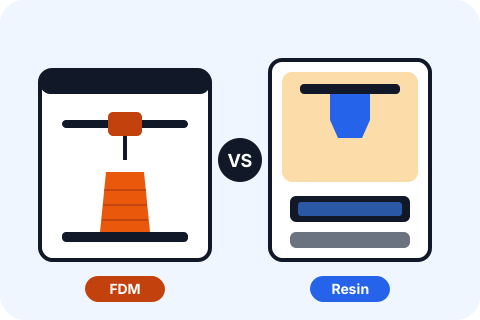
Quick answer: FDM melts plastic filament and is the better all-round choice. Resin cures liquid resin with UV light and gives much finer detail, but it needs gloves, ventilation and washing and curing after every print.
How they work
An FDM printer (fused deposition modeling) pushes melted plastic through a hot nozzle and builds a part line by line. A resin printer (SLA or MSLA) shines UV light through a screen into a vat of liquid resin and hardens a whole layer at once. The part hangs upside down from the build plate.
Resin vs FDM at a glance
| Property | FDM (filament) | Resin (SLA/MSLA) |
|---|---|---|
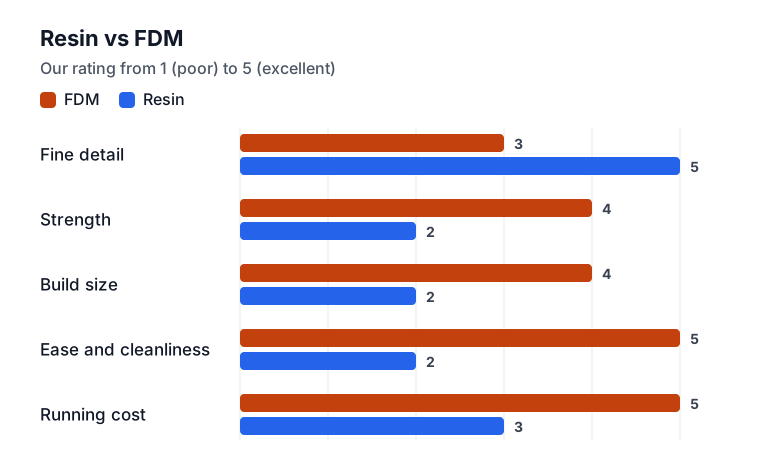
| Detail | Good, visible layer lines | Excellent, very fine detail |
| Typical layer height | 0.1–0.3 mm | 0.025–0.05 mm |
| Build size | Small to large | Usually smaller |
| Strength | Good, tough materials available | Standard resin is brittle |
| Materials | PLA, PETG, ABS, ASA, TPU, nylon and more | Standard, tough, flexible, castable resins |
| After printing | Remove supports | Wash, cure with UV, remove supports |
| Mess and safety | Low | Gloves, ventilation and care needed |
| Running cost | Low | Higher, plus consumables |
| Best for | Functional parts, prototypes, large prints | Miniatures, figures, jewelry and dental models |
When resin is the right choice
- Tabletop miniatures and figures with fine faces and textures
- Jewelry models, including castable resins for lost-wax casting
- Small, smooth display pieces where layer lines would show
- Dental and other precise small models
When FDM is the right choice
- Functional parts such as brackets, clips, holders and spare parts
- Larger prints like cosplay parts, planters and organizers
- Parts for outdoors or heat, in PETG or ASA
- Printing often without gloves, chemicals and cleanup
Not sure which filament to use on an FDM printer? Start with our filament comparison chart.
Resin safety in short
- Wear nitrile gloves and safety glasses whenever you handle liquid resin.
- Print and wash in a ventilated room, away from living and sleeping areas if you can.
- Keep resin, washing liquid and uncured parts away from children and pets.
- Never pour resin or dirty washing liquid down the drain. Cure leftovers in sunlight or UV light and dispose of them according to local rules.
- Isopropyl alcohol is flammable. Store it closed and away from heat.
Always follow the safety data sheet of your resin; products differ.
The cost difference
Filament is cheap and has almost no extra consumables. Resin usually costs more per kilogram, and you also use washing liquid, gloves and paper towels and replace the release film and, over time, the screen. For small miniatures the cost per print stays low; for large parts FDM is far cheaper. Work out FDM costs with the 3D print cost calculator.
Frequently asked questions
Is resin or FDM better for beginners?
FDM. It is cleaner, safer to handle, needs no chemicals for cleanup, and prints useful parts in cheap filament. Resin is worth it when fine detail is the main goal, such as miniatures or jewelry models.
Are resin prints stronger than FDM prints?
Standard resin is usually more brittle than PLA or PETG and can snap under impact. Tough and engineering resins exist, but for brackets, clips and outdoor parts FDM is normally the stronger and cheaper choice.
Is resin printing dangerous?
Liquid resin can irritate skin and cause allergies over time. Wear nitrile gloves and eye protection, work in a ventilated room, keep resin away from children and pets, and cure leftovers before disposal according to local rules.
Is resin printing more expensive?
Usually, yes. Resin often costs more per kilogram than PLA, and you also need isopropyl alcohol or a washing liquid, gloves, paper towels and replacement release films. Small miniatures still cost little each.