3D Printing Cost per Hour: How to Work Out Your Hourly Rate
One hour of 3D printing costs roughly $0.70 to $0.80 with a typical printer and PLA. Filament is the biggest part and electricity the smallest. Here is the calculation step by step, so you can find your own hourly rate.
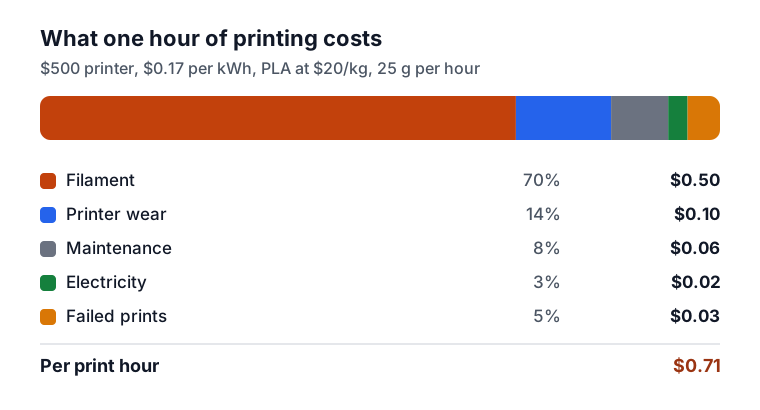
Quick answer: $500 printer, electricity at $0.17 per kWh, PLA at $20 per kg, 25 g of filament per hour: one print hour costs about $0.71. Without filament, just the machine, maintenance and power, it is about $0.18.
What goes into the cost per hour
- Printer wear: the printer price divided by its life in print hours.
- Maintenance: nozzles, belts, build plates and fans you replace each year.
- Electricity: average power in kW times your price per kWh.
- Filament: grams per hour times the price per gram.
- Failed prints: a small surcharge for prints that go wrong.
Worked example
A $500 printer lasts 5,000 print hours. You spend $60 a year on maintenance and print 1,000 hours. The printer averages 120 W and electricity costs $0.17 per kWh. PLA costs $20 per kilogram and the print uses 25 g per hour. About 5% of prints fail.
| Item | Calculation | Per hour |
|---|---|---|
| Printer wear | $500 ÷ 5,000 h | $0.10 |
| Maintenance | $60 ÷ 1,000 h | $0.06 |
| Electricity | 0.12 kW × $0.17 | $0.02 |
| Filament | 25 g × $0.02 | $0.50 |
| Failed prints | 5% on everything | $0.03 |
| Total | $0.71 |
Machine hourly rate without filament
Filament use per hour changes a lot from print to print, so many makers count material separately. What is left is the machine hourly rate: wear, maintenance and electricity. Here is how it depends on the printer price, with a 5,000-hour life, $0.06 maintenance and $0.02 electricity per hour:
| Printer price | Wear per hour | Machine hourly rate |
|---|---|---|
| $300 | $0.06 | $0.14 |
| $500 | $0.10 | $0.18 |
| $800 | $0.16 | $0.24 |
| $1,500 | $0.30 | $0.38 |
Then add material per print: the weight from your slicer times the price per gram. The filament cost calculator shows the price per gram and per meter.
Finding your own numbers
Printer life
There is no fixed number. Many people count on a few thousand print hours for a home printer before big repairs or a replacement make sense. If you print a lot, be cautious and use fewer hours.
Power use
The rating on the power supply is the maximum. Measure the real average with a plug-in power meter over a whole print. The electricity cost calculator shows the cost per hour, per print and per month.
Filament per hour
Divide the weight of a print by its print time; your slicer shows both. A 150 g print that takes 6 hours uses 25 g per hour.
An hourly rate for selling
If you sell prints, you need more than the bare cost. Add your labor, packaging, fees and profit to the machine rate and material. Count your labor separately in minutes per job, because the printer runs on its own most of the time. The selling price calculator turns this into a price, and our guide on how to price 3D prints explains the formula.
All numbers are examples. Use your own prices, power draw and print times for a result that fits your printer.
Frequently asked questions
How much does 3D printing cost per hour?
With a $500 printer, electricity at $0.17 per kWh and PLA at $20 per kilogram, one print hour costs about $0.71. Around $0.50 of that is filament. Without filament, the machine costs about $0.18 per hour.
How much filament does a 3D printer use per hour?
It depends on the nozzle, layer height and speed. With a 0.4 mm nozzle and common settings, 10 to 40 g per hour is typical, and fast printers can use more. Divide the weight your slicer reports by the print time to get your own number.
Should my labor be part of the hourly rate?
No, count it separately. The printer often runs for hours on its own; your work only happens when you prepare, remove and finish the print. Multiply the minutes per job by your own hourly rate.
What do 3D printing services charge per hour?
Services rarely charge by print time alone. Their prices also cover material, volume, finishing, order size, rent, staff and profit. Your own cost per hour is the floor for your price, not the price itself.