How to Dry Filament: Temperature and Time Chart
Most filaments absorb moisture from the air. Wet filament pops in the nozzle, strings and prints weak, rough parts. Drying it at the right temperature for a few hours fixes this, and a dry box keeps it that way.

Quick answer: dry PLA at 45 to 55 °C, PETG at 55 to 65 °C, ABS and ASA at 75 to 80 °C and nylon at 75 to 90 °C, for about 4 to 12 hours depending on the material. A filament dryer is the easiest way. Always check the label on your spool first.
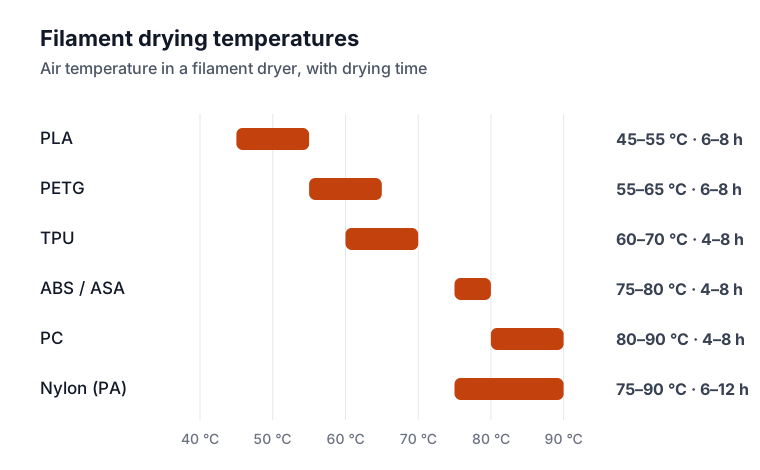
Filament drying temperature and time chart
| Filament | Temperature | Time | Absorbs moisture |
|---|---|---|---|
| PLA | 45–55 °C | 6–8 h | Slowly |
| PETG | 55–65 °C | 6–8 h | Moderately |
| TPU | 60–70 °C | 4–8 h | Quickly |
| ABS and ASA | 75–80 °C | 4–8 h | Moderately |
| PC | 80–90 °C | 4–8 h | Quickly |
| Nylon (PA) | 75–90 °C | 6–12 h | Very quickly |
Air temperature in a filament dryer or forced-air oven. The ranges combine the recommendations of Prusa and Bambu Lab (see sources below). Brands and blends differ, so the settings on your spool come first. Start at the lower temperature.
Signs your filament is wet
- Popping or crackling from the nozzle while printing. That is water turning to steam.
- More stringing than usual, even with settings that worked before.
- Rough or bubbly surfaces, small holes and blobs.
- Weak parts with poor layer adhesion that break more easily.
- Brittle filament that snaps on the spool, which often happens with old PLA.
Surface quality is usually the first thing to suffer. If a material that printed well suddenly looks worse, dry it before you change any slicer settings.
Four ways to dry filament
1. Filament dryer
A filament dryer is a small heated box made for one or two spools. It holds a steady, low temperature and many models let you print straight from the box. This is the safest and easiest method. Check that its maximum temperature is high enough for the materials you use: some only reach about 70 °C, which is too low for nylon and PC.
2. Printer bed with a cover
Some printer makers describe drying on the heated bed: the spool lies on the bed under a box or the closed enclosure. Bed temperatures for this are higher than the air temperatures in the chart, because much of the heat is lost, and the spool may need turning over halfway. Only use this method with your printer maker's instructions.
3. Food dehydrator
A food dehydrator with adjustable temperature works well for PLA and PETG. Many cannot go above about 70 °C, so they are not enough for ABS, nylon or PC. Cut out the trays if the spool does not fit.
4. Kitchen oven
Possible, but risky, and Bambu Lab advises against it: the heat inside a kitchen oven is uneven, and areas near the heating elements get much hotter than the setting. Many ovens also cannot hold such low temperatures, which can deform PLA and PETG. If you still use one, check the real temperature with an oven thermometer and never leave it unattended. Do not use a microwave: it heats unevenly and has no temperature control.
Check the spool
Cardboard spools and most plastic spools handle PLA and PETG temperatures. Some plastic spools soften or loosen at the higher temperatures needed for ABS, nylon or PC. Prusa, for example, recommends a screw through older black spools above 45 °C. If you are not sure, check the spool maker's specification or start at the lower temperature.
Keep filament dry after drying
Normal indoor air has about 45% to 65% relative humidity. Most filaments need less than 20% to stay dry for a long time, and freshly dried filament can start to take up moisture again within hours.
- Seal it. Store spools in an airtight box or a vacuum bag with desiccant.
- Watch the humidity. A cheap hygrometer in the box shows when the desiccant is used up.
- Refresh the desiccant. Replace it, or dry it as its maker describes, when it changes color or clumps.
- Print from a dry box. For nylon and TPU, feed the filament straight from a dry box or dryer.
Why it is worth the effort
A failed or weak print wastes filament, electricity and time. Drying a spool costs only a few cents of electricity. To see what a wasted print costs you, use the 3D print cost calculator. To learn which material suits your job, see our filament comparison chart.
Frequently asked questions
Can I dry PLA in a kitchen oven?
It is not recommended. Many kitchen ovens cannot hold a temperature as low as 45 to 55 °C, and the heat inside is uneven, which can soften PLA and fuse it on the spool. If you try it, check the real temperature with an oven thermometer and stay with the spool. A filament dryer is safer.
How long does dried filament stay dry?
Not long in open air. Bambu Lab notes that dried filament can start to absorb moisture within about 2 to 12 hours at around 55% humidity. Even at 20% humidity, Bambu Lab expects it to stay dry for only about 2 to 7 days, so keep stored filament in a sealed box with fresh desiccant, well below that.
Can I dry filament too long or too hot?
Too hot, yes: the filament softens and the strands stick together on the spool. Very long drying can also make some filaments more brittle. Stay within the temperatures and times in the chart and on your spool label.
Do I need to dry new filament?
Usually not if it came vacuum-sealed with desiccant. Nylon, TPU and PC often print better after drying even when new. If a new spool shows the signs of wet filament, dry it.
Sources
Values checked against these sources on .